Bandsaw Blade Anatomy: TPI, Kerf, Gullet, Tooth Set and Rake Angle Explained
Updated: 25 September 2026
A bandsaw blade may look simple, but its width, thickness, tooth spacing, tooth set, gullet and tooth geometry all influence how it cuts.
Understanding these terms makes it easier to read a blade specification, compare different blades and explain cutting problems accurately when speaking with a supplier or technical specialist.
Quick answer
Blade width and thickness affect the blade body's strength and compatibility with the machine. TPI and tooth pitch describe tooth spacing. The gullet provides room for chips. Tooth set creates side clearance and the cutting kerf. The tooth face and rake angle influence how the tooth enters and removes material.
Blade Anatomy video from the LENOX Institute of Technology.
The main parts of a bandsaw blade
The diagram below shows the main terms used when describing an industrial bandsaw blade.
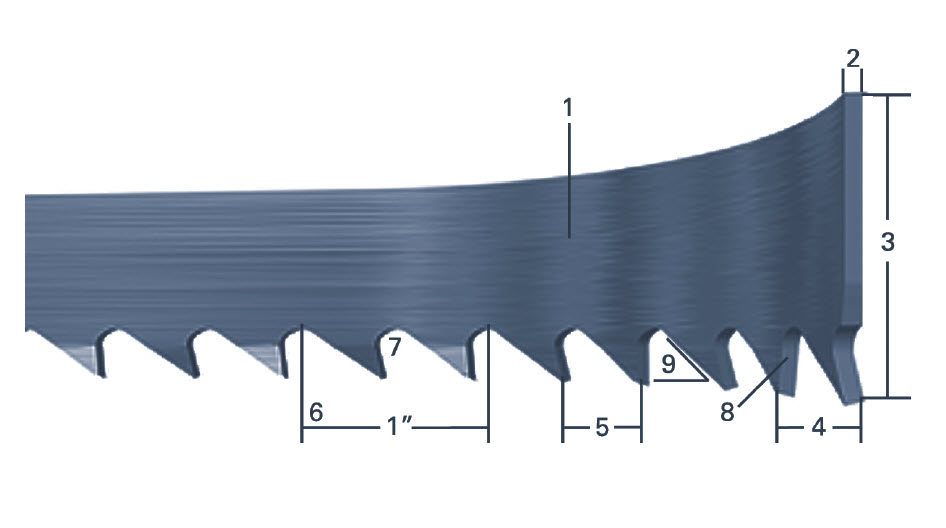
| Blade feature |
What it means |
Why it matters |
| Blade back |
The main body of the blade behind the toothed edge. |
Carries blade tension and provides the structural support behind the teeth. |
| Thickness |
The side-to-side thickness of the blade material. |
Affects blade strength, flexibility around the band wheels and machine compatibility. |
| Width |
Measured from the tooth tip to the back of the blade. |
Contributes to beam strength and must suit the bandsaw's blade specification. |
| Tooth set |
The controlled offset of teeth to either side of the blade. |
Creates clearance for the blade body and influences kerf, chip movement, finish and cutting behaviour. |
| Kerf |
The width of material removed by the blade during the cut. |
Kerf needs to provide enough clearance for the blade body to pass through the work without binding. |
| Tooth pitch |
The distance from the tip of one tooth to the tip of the next. |
Determines how closely the teeth are spaced and therefore how many teeth engage the material. |
| TPI |
Teeth per inch, a common way of specifying bandsaw tooth spacing. |
TPI must be matched to the size and shape of the section being cut. Too fine or too coarse a pitch can create cutting problems. |
| Gullet |
The curved space between adjacent teeth. |
Provides room for the chip as it forms and helps carry material away from the cut. |
| Tooth face |
The leading surface of the tooth where the chip is formed. |
Its geometry forms part of the cutting edge and influences how the tooth engages the workpiece. |
| Rake angle |
The angle of the tooth face relative to a line perpendicular to the direction of cutting. |
Changes the way the tooth enters the material and the feed force required. The appropriate angle depends on the blade design and application. |
Tooth pitch and TPI: what is the difference?
Tooth pitch is the physical distance between adjacent tooth tips. TPI expresses tooth spacing as the number of teeth per inch.
A fine pitch places more teeth into a given length of blade. A coarse pitch provides wider spacing and generally more gullet capacity for carrying larger chips.
Industrial bandsaw blades may use either a constant pitch or a variable pitch. A specification such as 4/6 TPI indicates a variable-pitch tooth pattern rather than every tooth being spaced identically. Variable tooth spacing can help interrupt repetitive cutting harmonics and is widely used on metal-cutting bandsaw blades.
Example blade specification
A specification such as 34 x 1.07 mm, 4/6 TPI describes a blade approximately 34 mm wide, 1.07 mm thick and using a variable 4/6 TPI tooth pitch. Blade length is specified separately to suit the machine.
Why the gullet matters
Every tooth produces a chip. The gullet provides temporary space for that chip while the tooth travels through the workpiece and carries it away from the cut.
This is one reason tooth pitch cannot be selected simply on the assumption that more teeth are always better. If the pitch is too fine for the amount of material being removed, the gullets may not have enough capacity for the chips being produced. Packed gullets can contribute to poor cutting performance and tooth damage.
Tooth set and kerf work together
The blade body needs clearance as it travels through the material. Bandsaw manufacturers achieve this by controlling the position of the teeth so that the cutting edges extend beyond the blade body.
The resulting cut is the kerf. Tooth-set patterns vary between blade families because different materials, section shapes and cutting conditions benefit from different chip-control and cutting characteristics.
| Set pattern |
Basic arrangement |
Typical purpose |
| Raker |
A repeating sequence of set teeth with an unset tooth in the pattern. |
A common general-purpose arrangement. |
| Vari-Raker |
Set sequence varies with the pitch and blade family. |
Used to manage vibration, cutting efficiency and finish. |
| Alternate |
Teeth alternate from one side to the other. |
Can be used where rapid material removal is more important than surface finish. |
| Wavy |
Groups of teeth gradually set to either side in a controlled pattern. |
Common on fine-pitch blades for thin or interrupted sections where vibration and burr need to be controlled. |
Tooth face, rake angle and tooth form
The tooth face is where chip formation begins. Its angle, combined with the overall tooth profile, influences how aggressively the blade penetrates the workpiece and how much feed force is required.
There is no single tooth geometry that is best for every job. Bandsaw manufacturers use different tooth forms for different materials, section sizes and production requirements. This is why two blades with the same width and TPI can still behave differently in the cut.
Blade anatomy is only part of the specification
Once you understand the geometry, the next question is what the blade is made from.
What blade anatomy can tell you when a cut goes wrong
Knowing the terminology also makes troubleshooting easier because you can describe exactly what is happening to the blade.
Packed gullets can point you towards tooth-pitch or chip-removal issues. Damaged tooth set can contribute to cutting problems. Tooth strippage, heavy wear, crooked cutting and premature blade breakage can each involve a combination of blade selection, machine setup, feed, speed, coolant and workholding factors.
For diagnosis rather than terminology, use our Bandsaw Troubleshooting Guide or read about the common causes of chipped or broken bandsaw blades.
Need help matching a bandsaw blade to the job?
Blade anatomy is only one part of selection. Machine specifications, blade length, material, section size and shape, production requirements and cutting conditions all matter. AusTech can help you narrow down the appropriate bandsaw blade for your application.
Shop Band Saw Blades Contact AusTech