How to Break In a New Bandsaw Blade
Updated:
Installing a new bandsaw blade and immediately running it at full production feed can damage the freshly formed tooth edges before they have had a chance to settle into the cut. A controlled break-in gradually conditions those edges, helping the blade produce consistent chips and supporting longer, more predictable blade life.
This guide is primarily for metal-cutting bi-metal bandsaw blades and follows the general LENOX break-in method used with many of the blades supplied by AusTech. Carbide, coated and other speciality blades may require different settings, so always check the instructions for the specific blade and bandsaw you are using.
Quick answer: Start with the correct band speed for the material. Reduce the feed rate or feed force so the blade is cutting at roughly 20% to 50% of the normal cutting rate, while still producing chips. Gradually increase the feed over several cuts until normal cutting rate is reached. For the LENOX bi-metal procedure, aim for approximately 150 to 300 cm² of total material cross-section cut during the break-in period.
Safety: Follow the bandsaw manufacturer's operating, guarding and blade-installation instructions and your workplace procedures. Stop and isolate the machine before fitting, tensioning or making adjustments that require access to the blade or guarded areas. Do not bypass machine guarding.
What is bandsaw blade break-in?
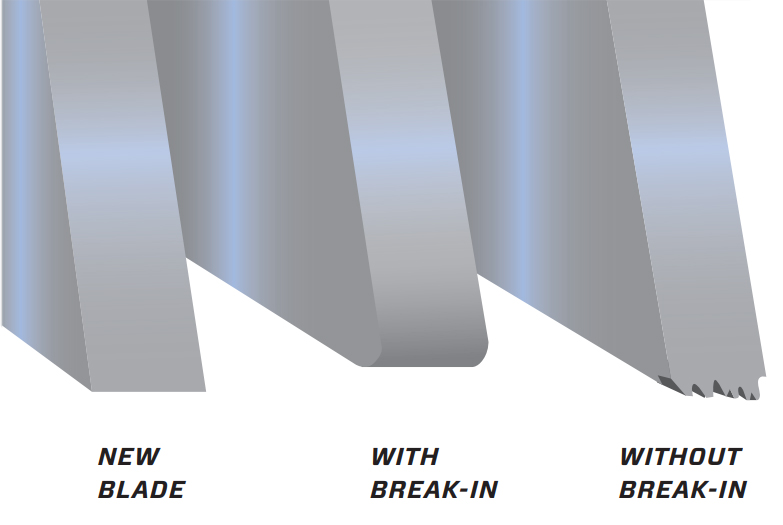
The teeth on a newly manufactured bandsaw blade have extremely sharp cutting edges. Although that sounds ideal, a very sharp tooth edge is also vulnerable to microscopic chipping when it is placed under full cutting pressure immediately.
Break-in uses controlled cutting pressure to gradually hone the leading edge of each tooth into a very fine radius. This gives the tooth edge more support before normal production cutting begins.
Why is blade break-in important?
A new blade that is pushed too hard during its first cuts can suffer small fractures or chips at the tooth tips. Once those cutting edges are damaged, the blade may wear faster, cut less consistently or become more susceptible to tooth damage.
Proper break-in is therefore less about making the blade temporarily cut slower and more about giving the new tooth edges a controlled introduction to normal cutting forces.
If you are troubleshooting premature wear, tooth stripping, vibration or other cutting problems, see our Bandsaw Troubleshooting Guide.
Before you break in the blade
Break-in cannot compensate for an incorrectly selected blade or a poorly set-up saw. Before beginning, check that:
- the blade specification and tooth pitch suit the material and section being cut
- the blade is installed in the correct cutting direction
- blade tension, tracking and guides are set according to the machine manufacturer's instructions
- the workpiece is securely clamped
- the chip brush and cutting fluid system, where applicable, are operating correctly
- the correct band speed has been selected for the material
Need help identifying blade terminology such as pitch, TPI, gullet and tooth set? See our Bandsaw Blade Anatomy guide.
How to break in a bi-metal bandsaw blade
| Step |
What to do |
What to watch |
| 1 |
Set the appropriate band speed for the material being cut. |
Use the blade supplier's cutting data rather than guessing. |
| 2 |
Reduce feed rate or feed force so the cutting rate is approximately 20% to 50% of normal. |
Mild steels generally require a larger reduction than more difficult-to-machine materials. |
| 3 |
Begin the first cut at the reduced rate. |
The teeth should still be forming chips rather than simply rubbing across the material. |
| 4 |
Once the blade has fully entered the workpiece, increase feed slightly. |
Avoid sudden increases that create chatter or vibration. |
| 5 |
Increase feed gradually over the following cuts until normal production cutting rate is reached. |
For the LENOX bi-metal procedure, complete roughly 150 to 300 cm² of total material cross-section during break-in. |
Use the LENOX bi-metal band speed chart as a starting point for selecting the appropriate band speed for common materials.
Important: The 20% to 50% figure refers to the reduced cutting rate achieved through feed rate or feed-force control. It does not mean simply setting the band speed to half of normal. For the LENOX bi-metal procedure, begin with the appropriate band speed for the material and only make small speed adjustments if excessive noise or vibration occurs.
How many cuts does blade break-in take?
Counting cuts alone can be misleading because the amount of material passing through the blade changes dramatically with workpiece size. A better guide is the total cross-sectional area cut.
For example, a solid 50 mm diameter round bar has a cross-sectional area of about 19.6 cm². Cutting approximately 150 to 300 cm² during break-in would therefore equate to roughly 8 to 15 cuts through that bar.
Smaller sections will require more cuts, while larger sections will require fewer. This is why there is no single correct answer such as "five cuts" or "ten minutes" for every application.
What should you watch during break-in?
| What you notice |
What it may mean |
What to do |
| Consistent chip formation and a stable cut |
The teeth are cutting rather than rubbing. |
Continue increasing feed gradually. |
| Very little chip formation |
Feed may be too light or another setting may be incorrect. |
Check the feed and cutting data rather than allowing the teeth to rub. |
| Excessive noise or vibration |
Cutting conditions or machine setup may need attention. |
Do not continue increasing feed. Check the setup and make a small band-speed adjustment if appropriate. |
| Chatter, tooth damage or a visibly poor cut |
The problem may extend beyond the break-in setting. |
Stop and check blade selection, pitch, clamping, tension, guides, coolant and machine condition. |
Common bandsaw blade break-in mistakes
- Starting at full feed. This places maximum cutting pressure onto brand-new tooth edges immediately.
- Reducing band speed but leaving feed too aggressive. Break-in is primarily about controlling the load on the cutting edge.
- Using so little feed that the blade only rubs. The teeth should still produce chips during break-in.
- Going back to full production rate after one cut. Increase feed progressively over several cuts.
- Ignoring vibration. Do not continue ramping up feed if the cut is unstable.
- Using the same procedure for every blade. Carbide, coated and speciality blades may have their own break-in requirements.
- Trying to break in a poorly selected blade. Incorrect tooth pitch or blade specification will not be fixed by a careful break-in procedure.
For a broader look at premature wear and blade damage, read Common Causes of Chipped or Broken Bandsaw Blades.
What about carbide and speciality bandsaw blades?
Do not automatically apply the same break-in settings to every blade construction. Carbide, coated, high-performance and application-specific bandsaw blades can require different cutting speeds, feed rates or break-in periods.
If you are unsure, use the procedure supplied for the exact blade or speak with AusTech about the blade, machine, material and section you are cutting before putting it into production.
Bandsaw blade break-in FAQs
Do I really need to break in a new bandsaw blade?
For the metal-cutting blades covered by this guide, proper break-in is recommended because it gradually conditions the new tooth edges before they are exposed to full production feed. Always follow the instructions supplied for the particular blade.
What feed rate should I use to break in a bandsaw blade?
The LENOX bi-metal method recommends reducing feed rate or feed force enough to achieve approximately 20% to 50% of the normal cutting rate, then progressively increasing it over several cuts.
Should I reduce the band speed during break-in?
Not automatically. For the LENOX bi-metal procedure used in this guide, start at the appropriate band speed for the material. Small adjustments can be made if there is excessive noise or vibration. Other blade manufacturers may specify a different break-in speed, so use the guidance for your particular blade.
How long does it take to break in a bandsaw blade?
It depends on the material and workpiece size. The LENOX bi-metal procedure uses approximately 150 to 300 cm² of total material cross-section cut rather than a fixed number of minutes or cuts.
Need help choosing or setting up your next bandsaw blade?
Blade life starts with matching the blade, tooth pitch and cutting conditions to the material and machine. AusTech can help you select the right bandsaw blade and cutting data for your application.
Shop Bandsaw Blades Contact AusTech