Compression Cutters for CNC Routing: How They Work and When to Use Them
Updated: 25 September 2026
When a CNC-routed panel has a finished surface on both faces, getting one edge clean is only half the job. An upcut spiral can favour the bottom face, while a downcut spiral can favour the top. A compression cutter combines both cutting directions in one tool so that, when it is correctly selected and positioned, the cutting action works towards the centre of the board.
That makes compression spirals particularly useful for cabinetmakers, joiners and manufacturers machining plywood, MDF, particleboard, melamine and other suitable laminated or composite panels where both faces matter.
Quick answer
A compression cutter normally has an upcut section near the tip and a downcut section above it. For the compression effect to protect both faces, the transition between those sections needs to sit within the material at the cutting depth being used. This is why material thickness, upcut length and pass depth matter just as much as cutter diameter.
Safety first
Always follow the CNC machine and cutter manufacturer's instructions, operating limits and guarding requirements. Isolate the machine before fitting, removing or inspecting tooling, use the correct shank and collet combination, secure the workpiece appropriately, maintain effective dust extraction and use suitable personal protective equipment for the material and task. Never use a damaged cutter, damaged collet or tooling outside its specified application.
What is a compression cutter?
A compression cutter, also called a compression spiral or compression router bit, combines two opposing spiral directions in the same cutting tool.
- Near the tip: the cutter normally has an upcut section.
- Above the tip: the cutter changes to a downcut section.
- When both sections engage correctly: cutting forces are directed towards the centre of the workpiece rather than away from its finished faces.
The result can be a cleaner edge on both the top and bottom surfaces than would normally be achieved with a single-direction spiral, particularly when machining double-sided laminated and layered materials.
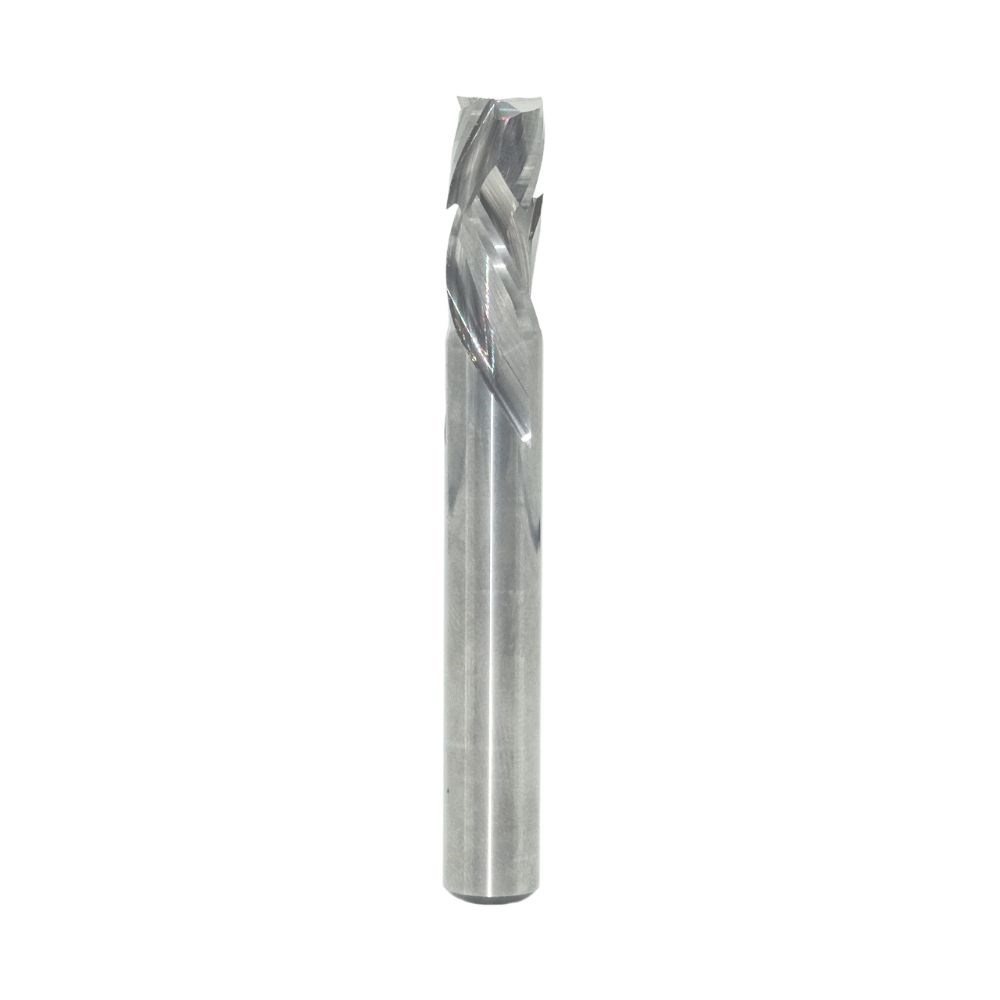
An example of a CNC compression spiral. Exact flute geometry, upcut length, cutting length and number of flutes vary between cutters.
Upcut vs downcut vs compression
| Cutter type |
Typical chip / cutting direction |
Face usually favoured |
Common reason to choose it |
| Upcut |
Moves chips upward |
Bottom face |
Chip evacuation, grooves and applications where the bottom edge is more important |
| Downcut |
Directs cutting action downward |
Top face |
Top-surface finish and applications where lifting the top edge is undesirable |
| Compression |
Upcut near the tip plus downcut above |
Top and bottom when geometry is correctly engaged |
Through-cutting panels where both faces need a clean edge |
For a deeper explanation of the two single-direction geometries, see AusTech's guide to upcut and downcut spirals.
The critical detail: upcut length and cutting depth
A compression cutter does not automatically create compression simply because its name says "compression". The cutter has to be positioned so that the correct part of the flute acts on each face.
If a first pass is shallower than the cutter's upcut section, the material may initially be seeing only upcut geometry. That can still lift fibres or chip the top surface even though a compression cutter is fitted.
Example
If a particular cutter has an 8 mm upcut section, a very shallow pass within that first 8 mm does not yet place the cutter's downcut section against the top face. The exact depth required depends on the cutter geometry, material thickness, toolpath and machine setup, so always check the actual cutter specifications rather than assuming all compression bits behave the same way.
This is one reason short-upcut compression cutters are available. Their shorter upcut section can make them more appropriate for applications where the required entry depth is relatively shallow. Some designs are specifically intended for mortising applications.
Where do compression cutters work best?
Compression geometry is particularly useful when both faces of a panel will remain visible or when breakout on either side would create rework or scrap.
- Double-sided melamine and laminated panels: useful where both decorative faces need protection.
- Plywood: can help control breakout across layered veneers when the cutter and cutting depth are correctly matched.
- MDF and particleboard: common CNC panel-processing applications, including laminated board.
- Nesting and profile cutting: particularly where components are being through-cut from sheet material.
- Suitable natural timber applications: compression geometry can also be useful where top and bottom edge quality is important, provided the selected cutter is approved for the timber and operation.
AusTech carries a range of compression spirals for CNC routing across different diameters, cutting lengths, flute counts and upcut configurations.
When might another cutter be better?
Compression is not automatically the best geometry for every routing operation.
| Application |
Why compression may not be the first choice |
Geometry to investigate |
| Deep narrow grooves or pockets |
Chip evacuation may be the dominant requirement |
Upcut spiral |
| Only the top face needs a premium finish |
Compression geometry may provide no useful advantage for the unseen bottom face |
Downcut spiral |
| Very shallow machining |
The cut may never reach the compression transition |
Downcut, upcut or short-upcut compression depending on the job |
| Different material such as plastic or non-ferrous metal |
Materials may require specialised flute geometry and chip evacuation |
Tooling specifically approved for that material |
How to choose a compression cutter
1. Start with the material
Confirm that the cutter is designed for the material you are machining. MDF, particleboard, plywood, melamine and natural timber can all place different demands on tooling.
2. Decide whether both faces actually need a clean edge
If only one finished surface matters, an upcut or downcut spiral may be a simpler match. Compression becomes particularly valuable when both sides need protection.
3. Check the upcut length
Compare the upcut section with your material thickness and intended cutting depth. The transition needs to be in the right place for the compression effect you are trying to achieve.
4. Check cutting diameter and cutting length
Diameter affects tool strength, feature size and machining requirements, while the cutting length needs to suit the workpiece thickness and operation.
5. Match the shank to the collet and machine
Never assume cutters with similar cutting diameters use the same shank. Confirm the shank size and the correct compatible collet specified for the machine.
6. Consider flute count
Compression spirals are available with different numbers of flutes. More flutes do not automatically mean a better result. Flute count affects chip load, available flute space and the relationship between feed rate and spindle speed, so it needs to suit the machine, material and manufacturer's operating data.
7. Check whether a standard or short-upcut design suits the operation
For conventional through-cutting, a standard compression design may be appropriate. For operations where reaching the compression transition quickly is important, a short-upcut or application-specific design may be worth considering.
Feeds, speeds and chip load still matter
The correct geometry cannot compensate for a poor machining setup. Feed rate and spindle speed determine the load being placed on each cutting edge, while chip evacuation, machine rigidity, workholding and tool condition all influence the result.
Avoid assuming that one feed and speed setting applies to every compression cutter. Start with the cutter manufacturer's data for the particular tool and material, then make controlled adjustments within the machine and tooling limits.
Excessive rubbing can generate heat and accelerate wear, while excessive tool load can cause poor finish, deflection or cutter damage. Sharp tooling and a sound collet are therefore just as important as selecting the right geometry.
Compression cutter troubleshooting
| Problem |
What to check |
| Top edge is chipping |
Check whether the cutting depth has reached the downcut section, confirm upcut length, inspect cutter sharpness and verify feed/spindle settings. |
| Bottom edge is chipping |
Check cutter position relative to the bottom face, tool condition, board support and whether the cutter geometry suits the material. |
| Fuzzy or rough edges |
Inspect the cutting edge for wear, check material compatibility and review feed rate, spindle speed and machine rigidity. |
| Burning or excessive heat |
Check for a dull cutter, excessive rubbing, inappropriate feed/spindle relationship, chip recutting or contamination on the tool. |
| Chatter or inconsistent finish |
Inspect the collet, tool runout, cutter condition, projection, workholding and machine condition. |
| Premature cutter failure |
Review tool load, collet condition, tool projection, entry strategy, material suitability and operating parameters. |
Look after the cutter and the collet
Good tooling performance depends on more than the cutting edge. Keep collets and mating surfaces clean, inspect them for wear, protect cutters from impact during storage and avoid running tooling once the cutting edge has become noticeably dull or damaged.
Compression spirals are also among the tooling types AusTech can assess and sharpen. Whether sharpening is appropriate depends on the construction and condition of the individual cutter.
Frequently asked questions
Is a compression cutter the same as an upcut or downcut spiral?
No. A compression cutter combines both directions in one tool, normally with upcut geometry near the tip and downcut geometry above it.
Do I have to cut the full panel thickness in one pass?
Not necessarily. The important issue is which section of the cutter is engaging the material at each depth. If both faces need protection, the cut needs to position the upcut/downcut transition appropriately. Short-upcut compression cutters are available for some applications where a shorter transition distance is useful. Always stay within the cutter and machine manufacturer's operating limits.
Why is a compression cutter still chipping the top surface?
A common point to investigate is whether the pass is deep enough to bring the downcut section into contact with the top face. Also check cutter sharpness, geometry, material compatibility, collet condition and machining parameters.
Can compression cutters machine MDF, plywood and melamine?
Many compression spirals are specifically designed for these materials, but check the specifications of the individual cutter before use. The AusTech compression range includes options intended for MDF, plywood, particleboard, melamine and double-sided laminated materials.
Should I choose a 2-flute, 3-flute or 4-flute compression cutter?
There is no universal best flute count. It needs to be matched to the material, cutter diameter, spindle speed, feed rate, machine capability and required finish. Follow the manufacturer's data for the specific cutter rather than choosing purely by flute count.
Can compression spirals be sharpened?
Many can. AusTech sharpens compression spirals and router bits, although the condition and construction of the individual cutter determine whether sharpening is practical.
Need the right compression cutter for your CNC?
Match the cutter to your material, panel thickness, upcut length, cutting depth and machine rather than choosing on diameter alone. Browse AusTech's compression spirals online or speak with our team if you need help selecting tooling for a particular application. We can also assess worn compression spirals for sharpening.
Shop Compression Spirals Contact AusTech