How to Select Bi-Metal Bandsaw Blades
Updated: 25 September 2026
The right bandsaw blade is not simply the one that fits the machine. Material grade, section size, wall thickness, whether you are cutting solids or structurals, and the number of teeth engaged in the cut can all affect blade life, cutting performance and finish.
For most metal-cutting applications, blade selection can be narrowed down by working through four questions: what fits the saw, what are you cutting, what tooth pitch is required, and what cutting parameters suit the application?
Quick answer
Start with the blade dimensions specified for your bandsaw. Then identify the material grade, shape and maximum cross-section being cut. Choose a blade family suited to that application, select the correct TPI for the section in contact with the teeth, and finally set band speed and feed for the material and machine.
Safety before changing or inspecting a bandsaw blade
Follow the machine manufacturer's operating, guarding and isolation instructions whenever fitting, adjusting or inspecting a blade. Appropriate machine guarding should remain in place during operation, and hazardous energy should be isolated before work requiring access to dangerous moving parts. Use the PPE and safe-work procedures required for your machine and workplace.
Step 1: Confirm the blade size your bandsaw requires
Before choosing tooth pitch or blade type, establish the blade dimensions specified for the machine:
- Blade length
- Blade width
- Blade thickness
Use the bandsaw manufacturer's specifications or machine manual rather than assuming a different width or thickness will be suitable. Blade dimensions affect how the band tracks around the wheels, how it is supported by the guides and how it behaves under cutting load.
Ordering tip: If you are unsure, give AusTech the saw make and model or the dimensions printed on the existing blade. Also tell us what material you normally cut so the blade size and tooth configuration can be considered together.
Step 2: Define the material and the way it will be cut
Blade selection changes significantly depending on the workpiece. Before choosing a blade, identify:
- material type and grade
- solid, tube, pipe or structural section
- diameter, width or wall thickness
- whether pieces are being cut individually or in a bundle
- whether the machine is hand-fed, general-purpose or used for production cutting
- whether the material is easy to machine or particularly hard, abrasive or prone to work hardening.
Which LENOX bi-metal blade family suits the job?
The following is a practical starting point based on LENOX application guidance and the blade families represented in the AusTech range. Exact selection still depends on machine capacity, material, dimensions and production requirements.
| Typical application |
LENOX family to consider |
Why consider it |
| General-purpose, hand-fed cutting and narrower blades |
DIEMASTER 2 |
General-purpose bi-metal option particularly suited to hand-fed applications. |
| General-purpose cutting on larger blades |
LENOX CLASSIC |
Versatile M42 bi-metal blade for general-purpose applications. |
| Mixed production work across solids and structurals |
CLASSIC PRO |
Designed as a versatile production-cutting blade across a broad range of metals. |
| Tube, pipe, structural sections and bundles |
RX+ |
Tooth geometry is designed around structural cutting and resistance to tooth stripping. |
| Demanding structural applications where additional wear resistance is required |
ARMOR RX+ |
Coated structural-cutting option intended for increased wear resistance. |
| Large beams and heavy-walled tube |
HRX |
Designed for wide structural sections, heavy walls and applications where pinching can be a concern. |
| Production cutting of solids with mild to moderate machinability |
QXP |
Designed for productive cutting rates and efficient tooth penetration. |
| Harder or difficult-to-cut alloys |
CONTESTOR GT |
High-performance option for tougher materials and work-hardening alloys. |
If your application involves unusual alloys, large production volumes, recurring blade failures or a mixture of very different sections, speak with AusTech before treating the table above as a final specification.
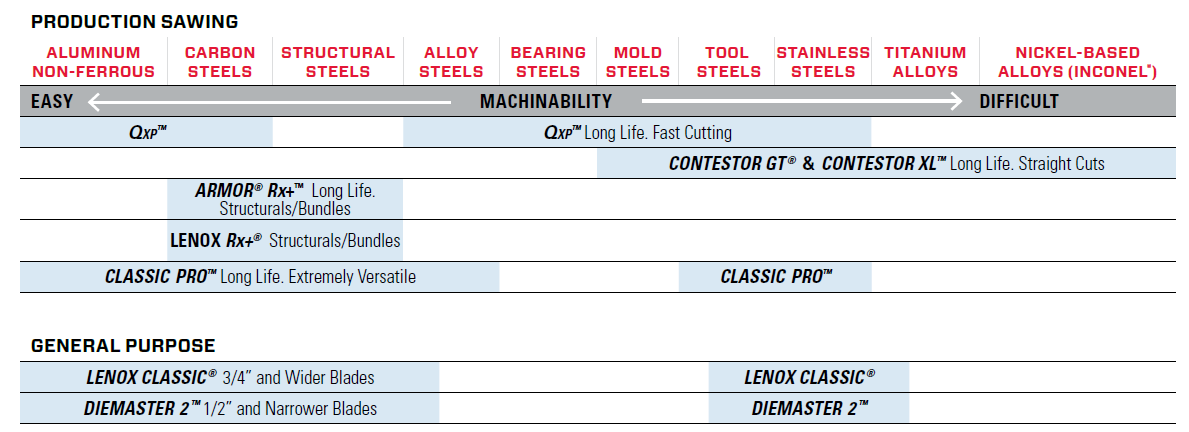 LENOX bi-metal product selection chart.
Step 3: Select the correct teeth per inch (TPI)
TPI is one of the most important parts of bandsaw blade selection. It determines how many teeth engage the workpiece and how much room is available in the gullets to carry chips out of the cut.
Do not choose TPI from the overall outside dimensions alone. Use the actual section being cut:
- Round solid: use the diameter.
- Square or rectangular solid: use the width of cut.
- Tube, pipe and structural sections: consider the wall thickness and changing tooth engagement as the blade passes through the section.
- Bundles or stacked material: tooth selection needs to account for the combined cutting condition rather than treating every piece as an isolated cut.
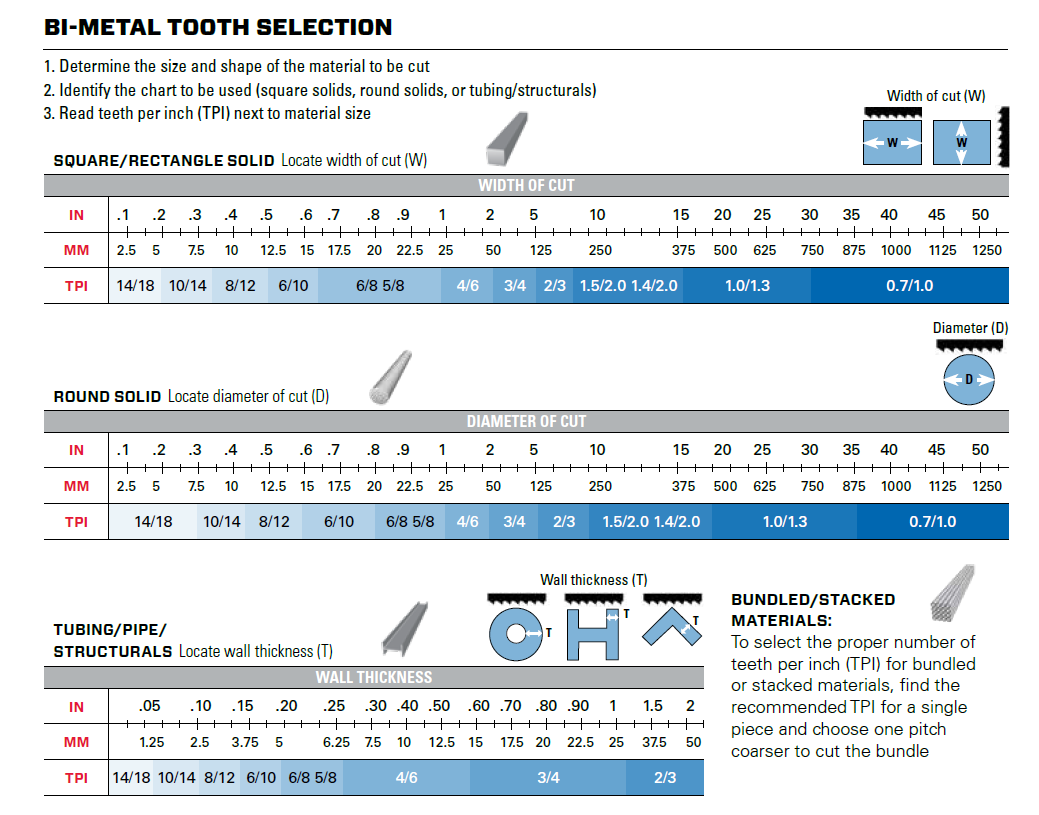 Use the appropriate section of the LENOX tooth selection chart for the material shape being cut.
Cutting bundles?
LENOX's bi-metal selection guidance recommends first finding the pitch for a single piece and then moving one pitch coarser for bundled or stacked material. Application-specific factors still matter, particularly where pieces can move or the blade repeatedly enters and exits thin sections.
What happens if the TPI is wrong?
Too fine a pitch can reduce gullet space and make chip evacuation more difficult in larger sections. Too coarse a pitch can leave too few teeth engaged, increasing load on individual teeth and contributing to rough cutting or tooth damage.
Premature tooth stripping, heavy gullet wear and poor cutting performance can therefore be signs that the blade pitch does not suit the workpiece.
Step 4: Set the band speed for the material
Blade selection does not end once the correct blade and TPI are installed. Band speed and feed also need to suit the material.
The LENOX bi-metal speed chart provides starting recommendations for common aluminium, carbon steel, alloy steel, stainless steel, tool steel, titanium, nickel-based alloys and cast iron grades.
Important: the published LENOX chart is based on specific reference conditions, including approximately 100 mm wide annealed material, a bi-metal blade and flood sawing fluid. LENOX provides adjustments for different material sizes, coolant conditions and heat-treated materials. Treat the chart as a starting point, not a universal machine setting.
View the LENOX Bi-Metal Bandsaw Speed Chart
Step 5: Check the blade is available in the required width and TPI
Once you have narrowed down the appropriate blade family and tooth pitch, check the available width, thickness and TPI combinations. Not every blade family is produced in every possible size.
Browse AusTech's bi-metal bandsaw blades
Before the first production cut: break in the new blade
A correctly selected blade can still suffer premature tooth damage if a new cutting edge is immediately subjected to full production feed. A controlled break-in allows the sharp new tooth tips to develop an appropriate cutting edge before normal cutting conditions are reached.
See our guide to breaking in a new bandsaw blade before putting a replacement blade into normal production.
Common blade-selection mistakes
- ordering from blade length alone and overlooking width or thickness
- choosing TPI from the outside size of tube rather than its wall and tooth engagement
- using the same tooth pitch for a bundle as for a single piece without checking the application
- using a general-purpose blade where the job is predominantly structural or difficult-alloy production cutting
- changing the blade without checking band speed, feed, coolant delivery or machine condition
- putting a new blade straight into full production without an appropriate break-in procedure.
Bi-metal or carbide bandsaw blade?
Bi-metal blades combine a high-speed-steel cutting edge with a fatigue-resistant backing and suit a wide range of general-purpose and production metal-cutting applications. Carbide-tipped blades can be a better option for some high-production, abrasive, large-section or difficult-to-cut applications, provided the saw is suitable for the required blade and operating conditions.
If your application sits outside normal bi-metal territory, see How to Select Carbide Bandsaw Blades.
Frequently asked questions
What information do I need to order the right bandsaw blade?
Have your blade length, width and thickness ready, along with the material grade, workpiece shape and dimensions, whether you cut pieces individually or in bundles, and whether the saw is used for general-purpose or production cutting.
How do I choose the correct TPI?
Use the dimension actually being cut. For solids this normally means diameter or width of cut. For tube and structural sections, wall thickness and changing tooth engagement are important. Use the manufacturer's tooth-selection chart for the specific blade system.
Why are teeth stripping from my bandsaw blade?
Possible causes include incorrect tooth pitch, excessive feed, poor blade break-in, workpiece movement, insufficient cutting fluid, damaged chip brushes or other machine and application issues. Blade failure should be diagnosed rather than automatically blamed on the blade itself.
Should I use a finer or coarser bandsaw blade for larger solid material?
Larger continuous cross-sections generally require progressively coarser tooth pitches so there is sufficient gullet capacity to remove chips. Use the relevant manufacturer's TPI chart rather than relying on a single rule of thumb.
Technical references
Not sure which bandsaw blade you need?
Tell AusTech your saw make or blade dimensions, material grade, section size and shape, and whether you are cutting individual pieces or bundles. We can help narrow down the blade family and tooth pitch for the application.